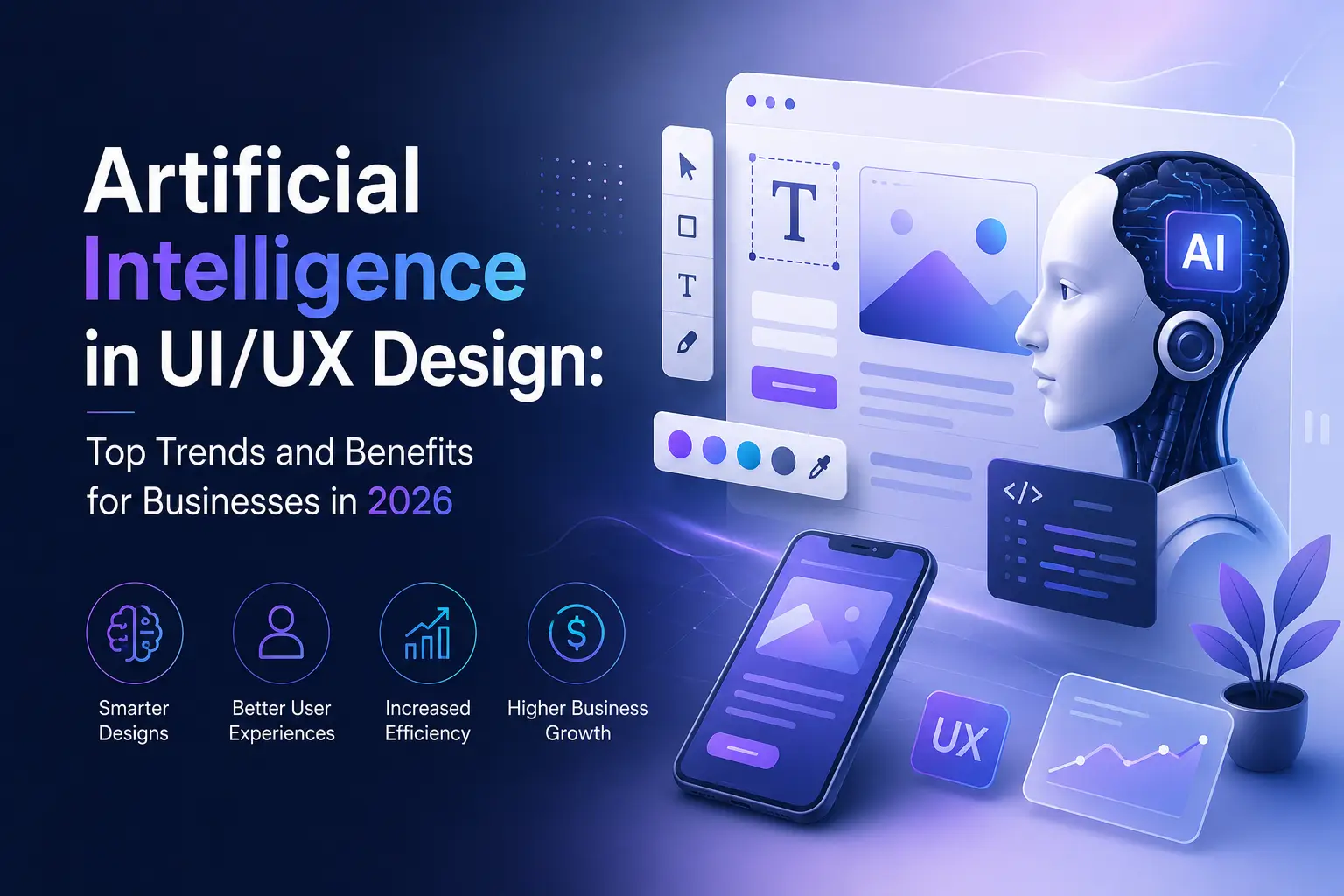
AI is no longer a futuristic concept in UI/UX design. In 2026, AI has become an integral part of how designers research, prototype, test, and optimize digital experiences. From generating wireframes in minutes to analyzing thousands of user feedback responses instantly, AI is transforming the way products are designed, refined, and delivered. As digital products become more complex and user expectations continue to evolve, AI is enabling design teams to work faster, make more informed decisions.
Recent industry research by Adobe’s State of Creativity suggests that AI is significantly improving creative productivity. These findings reflect a broader trend across UI/UX design, where AI is helping teams accelerate research, prototyping, content generation, accessibility improvements, and design iteration while allowing designers to focus more on strategic thinking, problem-solving, and user-centered work.
This blog explores the benefits of AI-powered UX research and UI development, the latest trends shaping the industry, and why organizations across industries are integrating AI into modern design workflows.
Artificial Intelligence Trends Enhancing UI/UX Design in 2026
Discover how advancements in AI-powered research, design automation, personalization, accessibility, predictive analytics, and intelligent prototyping are enabling teams to build user-centric digital experiences while streamlining modern design workflows.
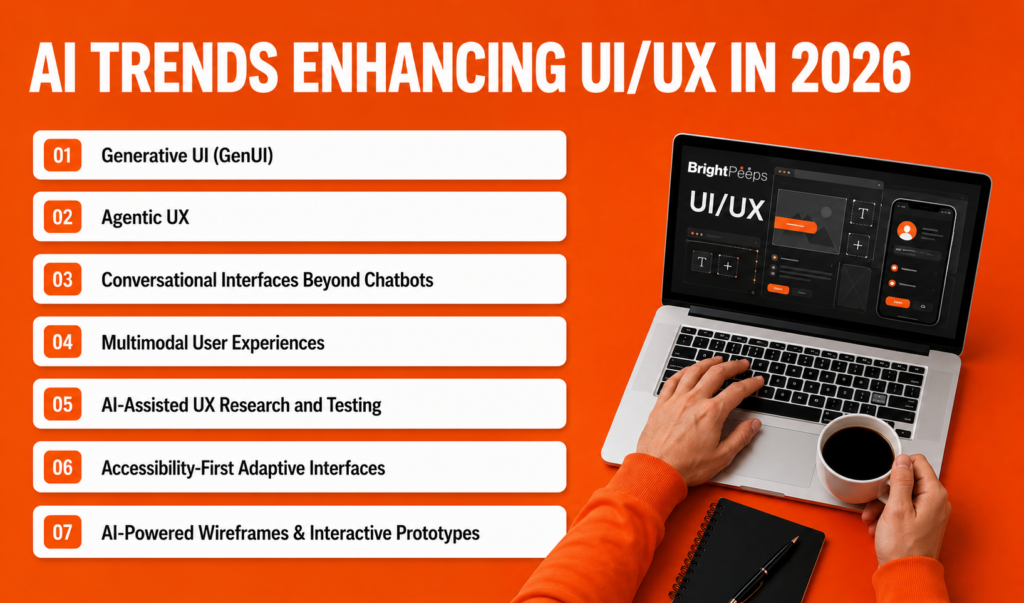
Generative UI (GenUI)
Generative UI is emerging as one of the most significant developments in the field. Instead of designing every possible screen or user state in advance, designers are increasingly using AI to generate layouts, workflows, and content structures dynamically based on user intent, context, available data, and current goals.
According to recent industry research, 93% of designers already use generative AI tools in their design workflow. As AI capabilities continue to mature, interfaces are becoming more adaptive and capable of delivering personalized experiences in real time.
Key takeaway: Generative UI enables applications to create personalized, context-aware interfaces in real time, reducing design complexity while improving user engagement and usability.
Agentic UX
Unlike traditional interfaces that simply react to user input, Agentic UX enables AI-powered systems to proactively assist users throughout their journey. Some of the latest Agentic UX capabilities include:
- Understanding user intent.
- Recommending the next best action.
- Automating repetitive workflows.
- Completing tasks with minimal user input.
Key takeaway: AI-powered agents are transforming digital products from passive tools into proactive assistants that help users achieve outcomes faster.
Conversational Interfaces Beyond Chatbots
Conversational experiences are evolving far beyond traditional chatbots. AI-powered conversational interfaces are becoming a primary interaction method across many digital products. Users can now ask questions, retrieve information, complete tasks, and navigate platforms using natural language. This trend reduces reliance on traditional navigation structures and creates more intuitive interactions that feel closer to human conversation.
Key takeaway: Natural language is becoming a core user interface, making digital experiences more intuitive and accessible.
Multimodal User Experiences
Modern users interact with digital products through multiple input methods, including text, voice, touch, images, and gestures. As a result, multimodal experiences are becoming an important UX trend in 2026.
Rather than relying solely on traditional screen-based interactions, organizations are designing experiences that allow users to switch seamlessly between different modes of communication depending on their environment, device, and preferences.
Key takeaway: Future digital experiences will support multiple interaction methods, allowing users to engage in the way that feels most natural to them.
AI-Assisted UX Research and Testing
AI is dramatically reducing the time required for UX research by helping researchers process large volumes of qualitative and quantitative data. Common applications include:
- Analyzing surveys and questionnaires.
- Summarizing user interviews.
- Identifying recurring usability issues.
- Detecting behavioral patterns.
- Generating research summaries and reports.
By automating analysis, UX teams can spend more time interpreting insights and improving user experiences.
Key takeaway: AI is making UX research faster, more scalable, and more data-driven, enabling teams to make informed design decisions more efficiently.
Accessibility-First Adaptive Interfaces
Accessibility is becoming a foundational element of modern UX design. Adaptive interfaces are increasingly using AI to accommodate diverse user needs and preferences. These interfaces can adjust layouts, content presentation, and interaction methods to improve usability for individuals with varying abilities. This approach moves accessibility beyond compliance requirements and toward creating genuinely inclusive user experiences.
Key takeaway: AI-powered accessibility features are helping organizations create more inclusive experiences that adapt to diverse user needs.
AI-Powered Wireframes & Interactive Prototypes
Instead of manually designing every screen from scratch, designers can use AI-powered tools to generate wireframes, user flows, and interface layouts from simple prompts, feature requirements, or product descriptions. This is why custom wireframes and interactive prototype services continue to play a critical role in validating ideas before development begins.
Key takeaway: AI-powered wireframes and interactive prototypes enable faster ideation, earlier validation, and more efficient collaboration, helping teams build intuitive and user-centered digital products.
Benefits of AI in Enhancing UI/UX Design and User Experiences
AI is creating value across the entire product lifecycle by helping teams design more efficiently, personalize user experiences, and optimize decision-making. As adoption continues to grow, organizations are leveraging AI to remain competitive in an evolving digital landscape.
- Faster Product Development
AI helps teams accelerate research, design, testing, and development workflows, enabling organizations to bring products and features to market more quickly. - Better Understanding of User Behavior
AI analyzes large volumes of user data, helping teams identify patterns, predict needs, and make more informed decisions. - Personalized User Experiences
Organizations use AI to tailor content, recommendations, navigation, and user journeys to individual users, improving engagement and satisfaction. - Improved Operational Efficiency
By automating repetitive tasks, AI allows teams to focus on innovation, strategy, and solving complex business challenges. - Smarter Decision-Making
AI-powered insights help product teams, designers, developers, and business leaders make data-driven decisions throughout the product lifecycle. - Enhanced Accessibility and Inclusivity
AI can help identify accessibility barriers and create adaptive experiences that better serve users with different needs and abilities - Competitive Advantage
As user expectations continue to rise, organizations are adopting AI to deliver faster, smarter, and more intuitive digital experiences that help them remain competitive. - Support for Innovation
AI enables teams to experiment, iterate, and explore new ideas more efficiently, fostering continuous improvement and innovation.
The BrightPeeps Advantage in AI-Powered UI/UX Design
We combine AI-powered efficiency with human creativity to build digital experiences that are intuitive, scalable, and business-focused. AI enhances our workflows by accelerating research, design, prototyping, and development, while every strategic decision is guided by experienced designers, developers, and product specialists.
- AI-Powered, Human-Led Design
We combine AI-driven efficiency with strategic thinking to deliver user experiences that are innovative, intuitive, and aligned with business goals. - Faster Design & Product Delivery
By integrating AI into research, ideation, wireframing, prototyping, and development, we reduce design cycles while maintaining quality and consistency. - User-Centered Decision Making
Every design decision is backed by user research, behavioral insights, and usability best practices to create experiences that solve real user problems. - Intelligent Wireframing & Prototyping
Our AI-assisted workflow accelerates the creation of wireframes and interactive prototypes, allowing ideas to be validated earlier and refined more efficiently. - Advanced AI Tools
We use tools including Figma, Adobe XD, Photoshop, and RAG to streamline designing, wireframing, prototyping, and development while maintaining human oversight throughout the design process. - Rigorous Testing & Validation
Every interface is evaluated through usability testing, accessibility reviews, functional testing, and iterative improvements before launching.
While AI enhances our workflow, every strategic decision is made by experienced designers, developers, and product specialists.
Conclusion
Artificial Intelligence is redefining the future of UI/UX design by enabling faster research, smarter design decisions, personalized user experiences, and more efficient product development. As AI continues to evolve, it is becoming an essential part of modern design workflows, helping organizations create digital products that are more intuitive, accessible, and user-centric.
However, the most successful digital experiences are built by combining AI-powered efficiency with human creativity, strategic thinking, and a deep understanding of user needs. At BrightPeeps, we embrace this balanced approach by ensuring every decision is guided by experienced UI/UX professionals. Whether you’re building a new product or enhancing an existing one, combining AI with human expertise can help create digital experiences that are scalable, engaging, and ready for the future
The cost of UI/UX design services depends on your project scope, requirements, and level of customization. Contact Bright Peeps at contact@brightpeeps.com or call us at +1 (302) 446 4747 for a personalized quote.
Project timelines vary based on complexity, features, and business requirements. We can provide a customized timeline after discussing your project.
Yes. We tailor our UI/UX design services to your business goals, industry, target audience, and specific project requirements.