“Our website just doesn’t feel right anymore.”
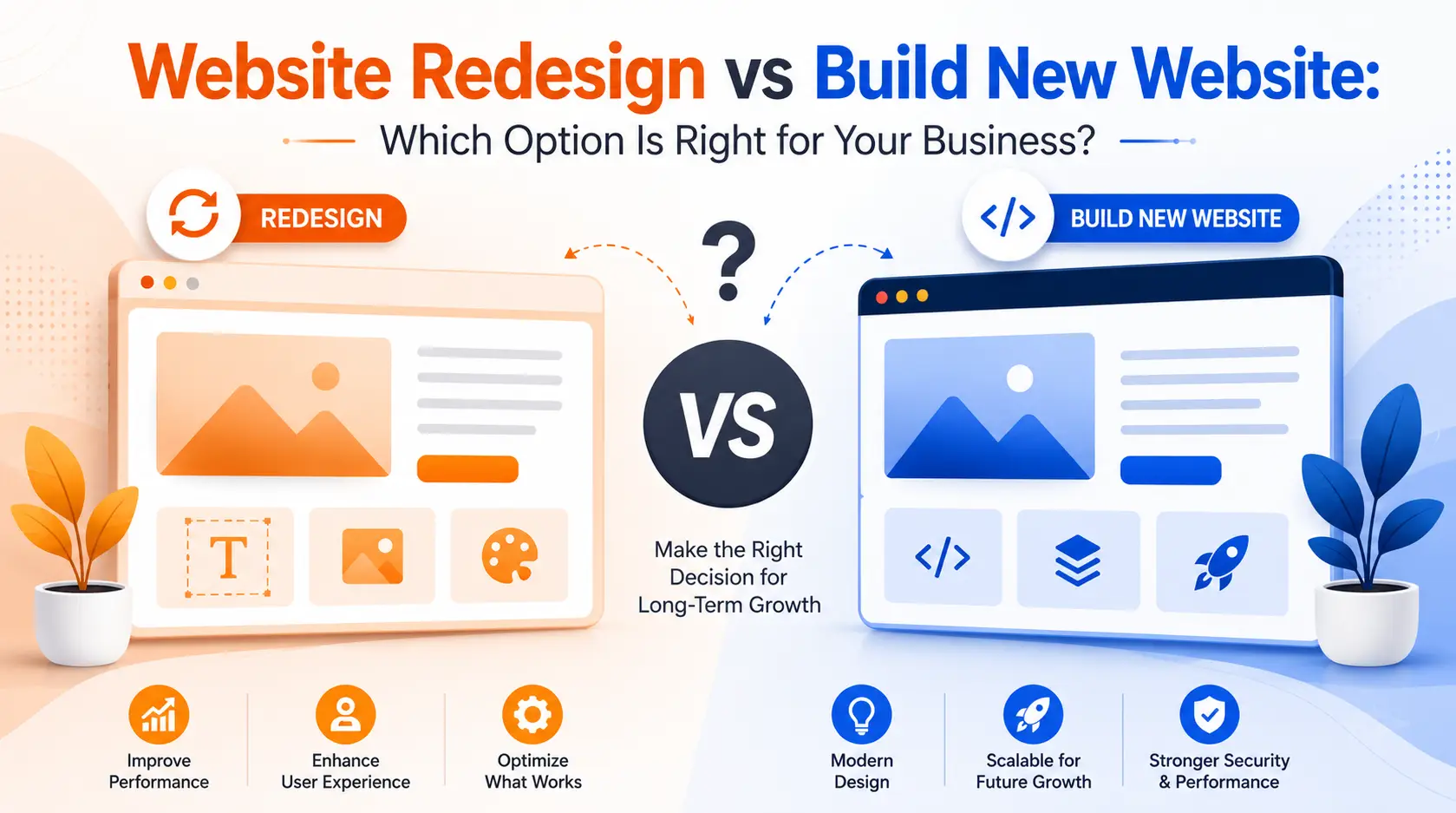
It usually starts with a simple realization. Maybe your marketing team notices a drop in leads. Perhaps your sales team hears prospects say the website looks outdated. Or maybe you’ve visited a competitor’s website and wondered why theirs feels faster, more engaging, and far more professional. That’s when one important question comes up: Website Redesign vs New Website: Which option is the right investment for your business?
At first, the answer may seem obvious. If the website looks old, redesign it. If it’s full of technical issues, build a new one. But the decision isn’t that simple. Your website is more than an online brochure. It’s your digital storefront, your most consistent salesperson, and often the first impression potential customers have of your business.
Whether you’re considering a website refresh or a complete rebuild, your choice can influence your brand’s perception, search engine rankings, user experience, and lead generation for years to come. So, how do you decide whether a website redesign is enough or if it’s time to build a brand-new website? Let’s break down the differences and help you determine which path best supports your business goals.
Understanding Website Redesign vs Website Rebuild
Before deciding whether to redesign your website or build a brand-new one, let’s look at a simple example.
Imagine walking into your favorite neighborhood coffee shop. The coffee is still excellent, the staff is friendly, and customers keep coming back. But the walls could use a fresh coat of paint; the menu boards look a little outdated, and the furniture has seen better days. Would the owner tear down the entire café and start from scratch?
Probably not. A renovation would be enough to refresh the space, improve the customer experience, and give the business a more modern look, all without changing what already works.
Now, imagine a different coffee shop.
The plumbing leaks, the kitchen is too small to handle growing demand, customers struggle to find the entrance, and the electrical system can’t support modern equipment. In this case, a fresh coat of paint won’t solve the underlying problems. The building itself has become the limitation. The smartest decision? Build a new one.
Your website is no different.
Some websites have a solid foundation but need a modern design, better navigation, faster loading speeds, and an improved user experience. A website redesign is often enough to breathe new life into them. Let’s take a better look.
What is a Website Redesign and When Does It Makes Sense?
A website redesign improves your existing website while keeping much of its underlying structure intact. Think of it as renovating your house instead of rebuilding it. A redesign may include:
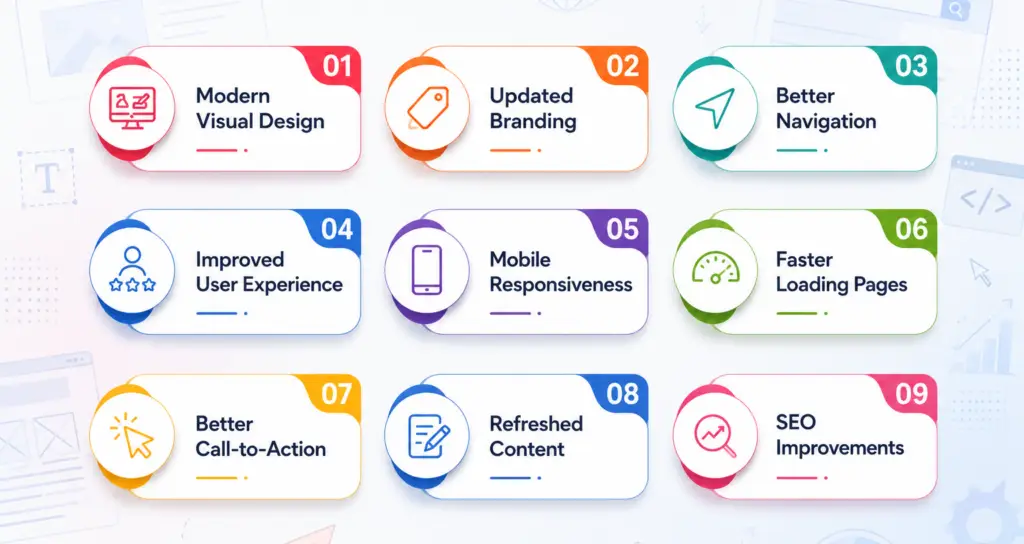
The website’s core architecture often remains the same, allowing businesses to preserve existing rankings, URLs, and valuable content where appropriate.
When a Website Redesign Makes Sense
A redesign is often the right choice when your website still performs reasonably well but feels outdated. Here are some common signs.
Your Branding Has Evolved
- Businesses grow.
- Logos change.
- Brand messaging matures.
- Color palettes evolve.
If your company has transformed over the last few years while your website still reflects your old identity, a redesign helps bring everything back into alignment.
Your Website Looks Old
Visitors form opinions within seconds. If your website still resembles something built several years ago, users may question whether your business is equally outdated. Old design creates hesitation, whereas modern design builds trust.
Mobile Experience Needs Improvement
Today, a significant share of website traffic comes from smartphones. If visitors constantly pinch, zoom, or struggle to navigate your pages, your website is losing potential customers before conversations even begin.
Your Website Loads Slowly
Even beautiful websites fail if they take forever to load. Optimizing code, compressing media, improving caching, and modernizing page layouts can significantly improve performance without requiring a complete rebuild.
Your Content Still Works
Suppose your blogs continue attracting visitors; your service pages rank well, and most importantly, customers still find useful information on your website. In that case, rebuilding everything from scratch may be unnecessary. Refreshing the presentation while preserving valuable content often delivers the best return.
What Does Building a New Website Mean, and When Should You Choose It?
Building a new website isn’t about giving your existing site a fresh coat of paint. It’s about starting with a blank canvas. A new website build means creating an entirely new digital experience from the ground up. Instead of working around old limitations, every aspect of the site is planned with your business goals in mind.
A successful website isn’t built on visuals alone. It starts with understanding your users, defining a clear strategy, and designing experiences that feel effortless. That’s when our UI/UX expertise comes in. We help businesses create intuitive, user-centric digital experiences through solutions such as:
- UI/UX Strategy & Consultation
- UX Audits & Evaluation
- Wireframes & Prototypes
- Tailored UI Design & Branding
A well-planned website build goes beyond attractive visuals to ensure your business is ready for both today’s users and tomorrow’s growth. This process typically includes:
- Creating a new site architecture and navigation
- Designing a modern, user-focused interface
- Choosing the right CMS or development framework
- Optimizing every page for search engines and performance
- Improving mobile responsiveness and accessibility
- Integrating CRMs, booking systems, payment gateways, or marketing platforms
- Building a scalable foundation that can grow alongside your business
While building a new website requires a larger investment than a redesign, it also offers the freedom to eliminate outdated code, improve security, enhance performance, and create a seamless user experience without being restricted by the old website’s structure.
When Is the Right Time to Build a New Website?
Not every website needs to be rebuilt, but there are situations where starting fresh is the smartest long-term decision.
Your Website Is Operating on Outdated Technology
Older websites often rely on:
- Unsupported plugins
- Obsolete CMS versions
- Custom code nobody understands
- Security vulnerabilities
Fixing these repeatedly becomes more expensive than replacing them altogether.
Your Business Has Evolved
Businesses rarely stay the same for years. Perhaps you’ve expanded your services, entered new markets, introduced new products, or completely repositioned your brand. If your website no longer reflects who you are today, rebuilding it will help your online presence grow alongside your business.
You’re Planning to Add New Features
Features like eCommerce, customer portals, appointment scheduling, membership systems, multilingual support, or custom integrations often require a stronger technical foundation. Building a new website ensures these features work smoothly without compromising performance.
The User Experience Is Broken
If visitors struggle to:
- Find information
- Complete forms
- Navigate pages
- Purchase products
The issue usually isn’t visual; it’s structural. That often calls for a complete rebuild.
Your Website Can’t Scale with Your Growth
Your website should support your business, not limit it. If every update requires developer assistance, adding new pages is complicated, or the platform struggles to handle increasing traffic, it’s a strong indication that your current website has reached its limits. A new website provides the flexibility to adapt as your business continues to grow.
Now that you understand when a website redesign makes sense and when it’s better to build a new website from scratch, it’s time to compare both approaches side by side.
Redesign vs New Website: A Side-by-Side Comparison
The table below highlights the key differences to help you make an informed decision.
| Comparison Factor | Website Redesign | New Website Build |
| Purpose | Refreshes and improves your existing website while retaining its core structure. | Creates an entirely new website with a new structure, design, and technology stack. |
| Investment | Lower upfront cost since much of the existing website is reused. | Higher initial investment due to planning, design, development, and migration. |
| Project Timeline | Faster to complete because the existing foundation is retained. | Takes longer as every component is built from scratch. |
| Website Structure | Preserves the current architecture with selective improvements. | Reimagines the entire site architecture based on current business goals. |
| Design Flexibility | Best for updating visual design and improving user experience. | Offers complete creative freedom with no limitations from the existing website. |
| Technology | Continues using the current platform unless specific upgrades are needed. using the current platform unless specific upgrades are needed. | Enables you to adopt modern CMS platforms, frameworks, and development technologies. |
| SEO Impact | Existing rankings can often be maintained with careful optimization. | Requires a well-planned SEO migration, including redirects and content mapping. |
| Scalability | Suitable when the current website can still support future growth. | Built with scalability in mind, making it easier to add new features over time. |
| Business Fit | Ideal when your branding or design has evolved, but the website still functions well. | Best when your business model, services, or digital strategy has changed significantly. |
| Long-Term Value | Extends the life of your existing website with targeted improvements. | Provides a future-ready digital foundation designed for long-term growth. |
Neither option is inherently better than the other. A website redesign is the right choice when your existing website has a strong foundation and simply needs a visual or usability upgrade. On the other hand, if your website is outdated, difficult to maintain, or no longer aligns with your business objectives, investing in a new website build is often the smarter long-term decision.
Final Thoughts
There isn’t a universal answer to the redesign-versus-rebuild debate. Every business has different goals, challenges, audiences, and growth plans. If your website has a strong foundation but needs a modern appearance and improved usability, a redesign is often the smartest investment. If outdated technology, poor architecture, scalability issues, or changing business needs are holding you back, building a new website is usually the better long-term decision.
The important thing is not choosing the cheaper option. It’s choosing the option that supports where your business is going, not where it has been. Because in today’s digital world, your website isn’t just another marketing asset. It’s often the first conversation your business has with every potential customer.